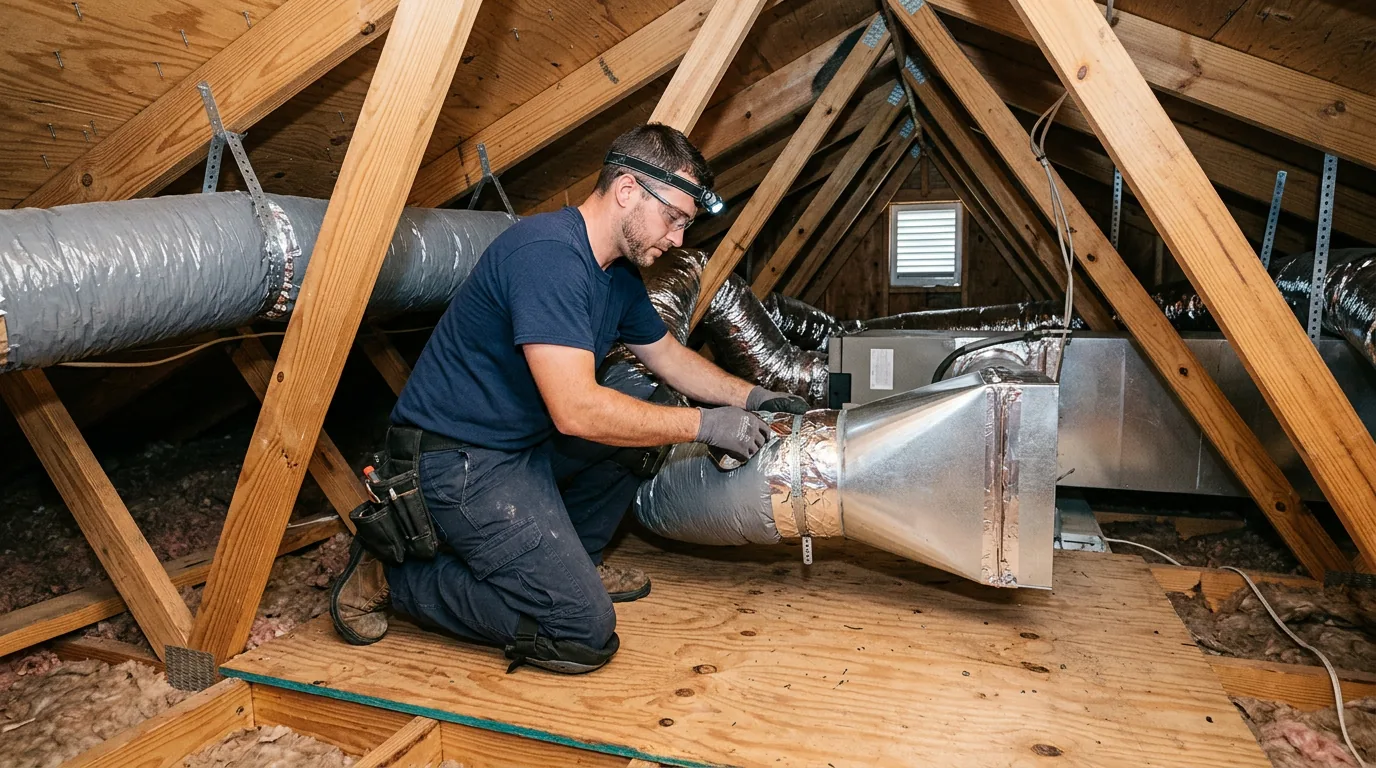
Duct replacement means removing old air ducts and installing new ones. Ducts are the pathways that carry cooled air from your air conditioner to your rooms. This is not a single fix with a single cause. Weak airflow, uneven cooling, or high energy use can come from duct problems. They can also come from a clogged filter, a failing blower, or an undersized system. Only a qualified HVAC technician can measure the system and confirm which case you have. This guide explains what duct replacement involves, which observations are safe to make, and what evidence a technician needs before any repair-or-replace decision.
What Duct Replacement Means
Your cooling system has two sides. One side makes cold air. The other side is the duct system that delivers it. Ducts include supply ducts, which carry cool air out to rooms, and return ducts, which pull air back to the equipment. Duct replacement means replacing sections of, or an entire, duct system. This may be needed when ducts are damaged, collapsed, disconnected, poorly sealed, or the wrong size.
Replacement is one possible outcome. Sometimes sealing, insulating, or repairing a section is enough. In other cases, the duct design itself limits airflow, and no repair will fully fix it. That difference is why measurement matters before any decision.
How Ducts Affect Cooling and Airflow
Cooling depends on moving the right amount of air across the evaporator coil and spreading it evenly through the home. The U.S. Department of Energy’s home cooling guidance treats the whole cooling cycle — equipment, distribution, and maintenance — as one system, not separate parts. If ducts leak, are crushed, or are too restrictive, cooled air escapes into attics or crawl spaces. Rooms far from the air handler get less airflow. The equipment then runs longer to keep up.
In Florida’s hot climate, long cooling seasons put steady demand on air distribution. That does not mean every Florida home has the same duct conditions. Construction, duct location, and system age all vary. It does mean duct performance affects comfort and operating cost for much of the year.
Duct Issue or Something Else?
Several symptoms can look like a duct problem but have other causes. Use this comparison to sort what you see before calling for service:
| Observation | Possible duct-related cause | Possible non-duct cause |
|---|---|---|
| One or two rooms weak or warm | Disconnected, crushed, or leaking branch duct; closed damper | Filter or vent restriction; equipment issue |
| Weak airflow at every vent | Return-side restriction or major duct leakage | Clogged filter; blower or equipment problem |
| Runs constantly, home still warm | Air-distribution losses | Cooling-capacity issue, refrigerant problem, or equipment fault |
| Whistling, rattling, or banging | Loose duct sections, high static pressure | Blower or mechanical issue |
Notice the pattern. The same symptom can have several causes. No symptom alone confirms a failed part or a duct problem. These are possibilities, not diagnoses.
Safe Homeowner Checks
Before scheduling service, a few safe observations give a technician useful information:
- Check the air filter. A loaded filter restricts airflow across the whole system. ENERGY STAR’s maintenance checklist lists filter checks as a basic homeowner task. If the filter is dirty, replace it with the correct size and type before drawing conclusions.
- Confirm supply vents are open and unblocked. Furniture, rugs, or closed registers reduce delivered airflow.
- Note which rooms are affected. A pattern in certain rooms points more toward distribution. A whole-home pattern points more toward the system as a whole.
- Listen for new noises from ducts or the air handler, and note when they occur.
- Look for visible duct damage in accessible areas only — a crushed flex duct in an attic you can safely view, for example. Do not climb into confined or unsafe spaces.
Stop and request qualified help right away if you notice smoke, a burning electrical smell, repeated breaker trips, water where it should not be, severe noise, or an outdoor fan that is not spinning. Carrier’s guidance on outdoor-fan problems stresses electrical-safety boundaries. Do not open panels, test capacitors, or bypass any safety control. Those steps belong to trained technicians with the right equipment.
What a Qualified Technician Measures
A real diagnosis requires measurements, not symptom matching. A technician or estimator deciding whether duct replacement is warranted should verify:
- Total external static pressure — how hard the blower works against duct resistance.
- Airflow volume — whether the system moves the air it was designed to move.
- Duct leakage — where and how much conditioned air is escaping.
- Return-path condition — whether the system can pull enough air back.
- Equipment condition and capacity — confirming the cooling side works before blaming the ducts.
- Duct sizing and layout — whether the existing design can serve the home at all.
These measurements separate an air-distribution problem from a cooling-capacity problem. They also show whether sealing or partial repair is enough, or whether replacing duct sections is the sounder choice. Any proposal should show you the evidence behind it.
Maintenance and Prevention
Whatever the outcome, routine maintenance protects airflow. ENERGY STAR’s maintenance checklist covers filter changes, drain and coil care, control checks, and professional blower inspection. These tasks keep air moving as designed. Schedule professional maintenance regularly, keep vents clear, and replace filters on the schedule your system and household conditions require. If ducts are accessible, periodic visual checks for crushed or disconnected sections can catch problems early. Leave any repair to qualified hands.
Choosing the Next Step
Your decision path depends on what the observations and measurements show:
- Filter or vent restriction? Safe maintenance may resolve it — no duct work needed.
- Air-distribution problem? A technician’s measurements determine whether sealing, repair, or duct replacement fits.
- Cooling-capacity or equipment issue? Duct replacement alone will not fix it. The equipment conversation comes first.
If you need professional evaluation, request service so a technician can measure the system rather than guess. Velocity offers 24/7 repair availability, and same-day dispatch may be available when a technician is available. Velocity states that it does not add a separate night or weekend service charge. EPA-certified refrigerant handling practices apply when refrigerant work is performed, and warranty-aware repair practices apply when manufacturer coverage remains active — warranty terms and registrations vary by equipment and documentation.
For related reading, see our pages on air conditioning repair and air conditioning maintenance.
Frequently Asked Questions
How do I know if my ducts need service?
You cannot diagnose duct problems from symptoms alone. Look for signs the duct system needs evaluation: rooms with weak airflow, uneven cooling, new duct noises, or visible damage in accessible areas. Any of these warrants a professional evaluation to determine whether repair or replacement is the right response.
What should I gather before calling for service?
Note which rooms are affected, whether airflow is weak everywhere or only in spots, when symptoms started, and whether the filter is fresh. Add any noises you hear and when they occur, plus any visible duct condition you can safely observe. This helps the technician focus measurements quickly.
Can a homeowner safely fix ducts?
Safe homeowner actions are limited to filter changes, clearing vents, and observation. Do not open energized equipment, test capacitors, bypass safety controls, or handle refrigerant. Duct repair and replacement themselves require trained technicians with proper tools and sealing materials.
What does a technician check on ducts?
A qualified technician measures static pressure and airflow volume, tests duct leakage, inspects the return path, verifies equipment condition and cooling capacity, and evaluates duct sizing and layout. Those measurements determine whether repair, sealing, or replacement is justified.
When is duct replacement the better choice?
When measurements show the duct system cannot deliver design airflow — due to damage, leakage, or undersized sections — the technician weighs whether targeted repairs can restore performance or whether replacing duct sections is the more reliable long-term answer. That judgment depends on measured evidence, not on the symptom alone.