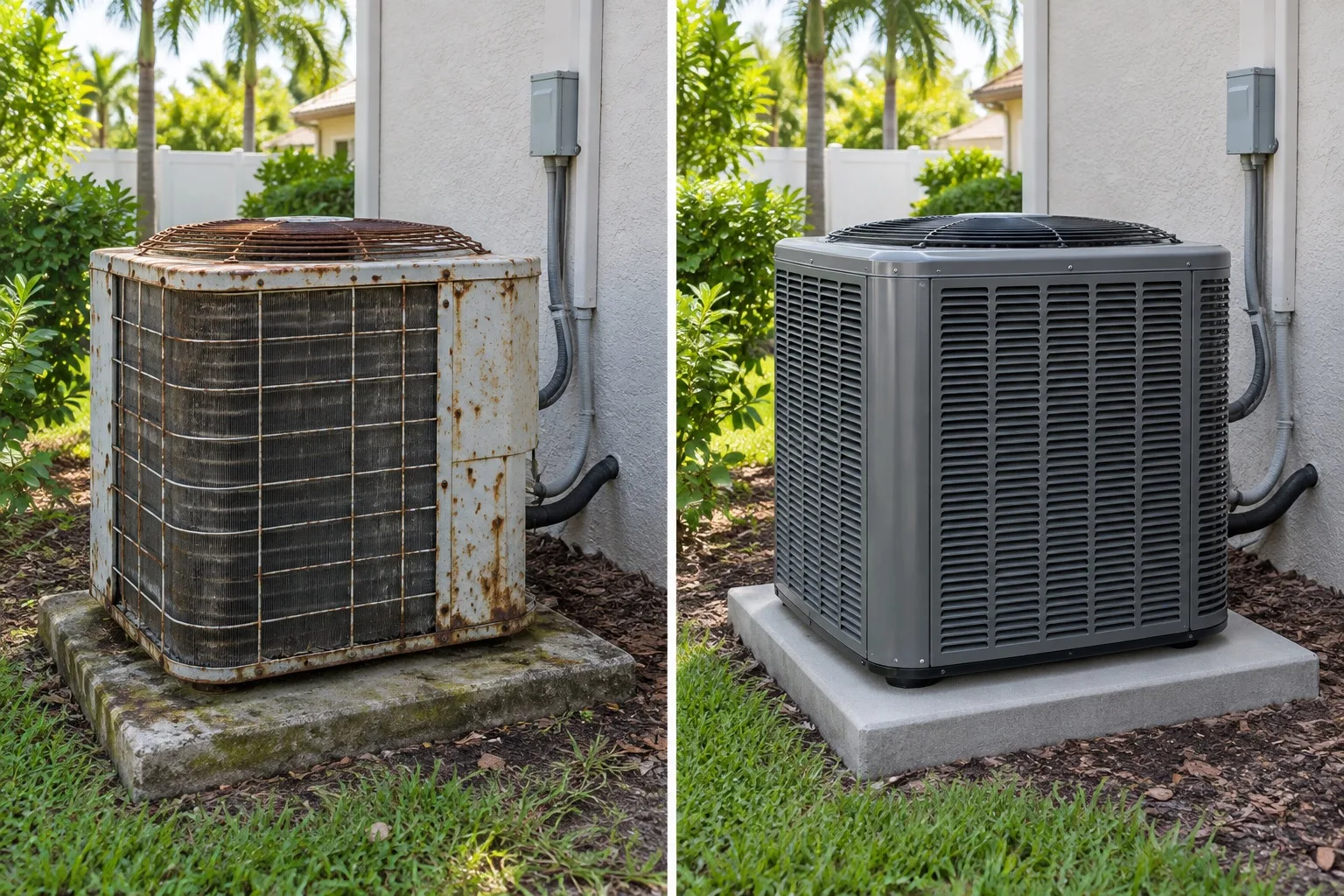
The Complete Guide to Heat Strip Replacement in Tampa
Everything Tampa homeowners need to know about heat strip replacement — what heat strips are, how they fail, how they’re diagnosed, what replacement involves, what it prevents, and how to keep the new ones healthy. No brand pitch (we service all major equipment), no jargon without explanation. This is the complete guide.
What Heat Strips Are
Heat strips are electric resistance heating elements — nichrome wire coils inside your air handler that convert electricity directly into heat. They serve three roles: supplemental heat (assisting the heat pump below the balance point), defrost tempering (warming the air during defrost cycles so the cold blast doesn’t reach your rooms), and emergency heat (the full backup when the heat pump can’t run). They’re staged in banks (typically 5kW steps) by sequencers that engage them seconds apart, protecting your electrical panel from the 40–80 amp total load hitting at once. The economics: resistance heat runs at COP 1.0 versus the heat pump’s 3–4 — the most expensive heat in your home per BTU, which is why correct control matters as much as correct condition.
How Strips Fail
Element burnout: thermal-cycle fatigue opens the nichrome circuit — the bank that draws zero amps when energized. Sequencer failure: the staging switch fails open (bank never engages) or closed (bank never releases — the stuck-on bill disaster). Contactor welding: high-current switching welds contacts closed — continuous energization. Terminal degradation: heat and corrosion at the high-current connections — rising resistance, rising heat, eventual failure. Control misconfiguration: wrong auxiliary lockout, failed outdoor sensor, bad thermostat logic — strips commanded on unnecessarily. Surge damage: Tampa’s storm season against high-current electronics. Wiring deterioration: heat-brittled insulation across years of thermal cycling. The failure modes are electrical, diagnosable, and — with the annual inspection — mostly catchable before they become bill disasters.
How Failure Is Diagnosed
- Symptom review: the bill history, the AUX indicator behavior, comfort patterns — the story the system has been telling.
- Amp draw measurement: each bank metered against its nameplate — zero where there should be draw (failed element), draw where there should be zero (stuck sequencer/contactor).
- Sequencer testing: staged on/off with timing verified — the staging logic proven, not assumed.
- Contactor and terminal inspection: welded contacts found visually, heat-damaged terminals identified — the physical evidence.
- Control verification: thermostat programming, outdoor sensor, auxiliary lockout — the command chain that decides when strips engage.
- Heat pump performance check: because the strips may be compensating for a heat pump problem — the diagnosis that prevents fixing the messenger instead of the cause.
What Replacement Involves
Electrical lockout and meter verification — the 240V circuit proven dead before work begins. Assembly replacement — the failed bank or full assembly swapped for the genuine-spec replacement with correct kW for the circuit (wire gauge and breaker rating respected). Sequencer and contactor service — staging components tested or replaced. Terminal renewal — heat-damaged connections replaced and torqued. Amp draw commissioning — every stage verified against nameplate. Control configuration — auxiliary lockout set so the new strips engage only when justified. Typically 1–2 hours; the sealed refrigerant circuit is never opened — this is electrical work from start to finish.
What Replacement Prevents
- Runaway electric bills. The stuck-on strip bank is the single most common cause of shocking winter bills — eliminated.
- No-heat vulnerability. Failed elements discovered in fall testing, not on the coldest night — the backup restored before it’s needed.
- Electrical hazards. Degraded terminals and welded contactors are the failure modes with safety stakes — renewed.
- Heat pump overwork. Correctly controlled strips stop compensating for (and masking) heat pump problems — each system doing its designed job.
- Cascade damage. The overheated terminal that would have taken out the wiring harness — caught and renewed.
- Repeat visits. The assembly-level replacement with renewed terminals and verified staging — done once, done right.
Keeping the New Strips Healthy
Annual strip circuit inspection with the heating tune-up — terminals, sequencers, contactors, amp draw. Surge protection — whole-home protection for the high-current controls. Correct lockout configuration maintained — the strips engaging only when thermodynamically justified. Prompt symptom response — bill spikes and constant AUX indicators investigated immediately. Documentation — the replacement date, kW, and commissioning measurements filed. The new assembly’s lifespan is determined less by its manufacturing and more by its maintenance — the care program is the durability program.
Equipment Notes
Modern heating systems across all major brands share the heat strip fundamentals this guide describes — high-efficiency scroll compressors, ECM blower motors, nichrome strip assemblies, and sequencer staging standards — and we service equipment from the full range of manufacturers with genuine-spec components. Our technicians follow strict electrical lockout procedure, and replacements are performed to protect your manufacturer warranty.
Questions About Heat Strips in Tampa
How do I know if I need replacement or just a repair?
The diagnostic testing decides: single failed component in a healthy assembly — repair; systemic aging across elements, sequencers, and terminals — assembly replacement. The amp draw and inspection results make the case.
How long does replacement take?
Typically 1 to 2 hours — lockout, swap, staging verification, amp draw commissioning, control configuration. Scheduled visits; emergency service available when the failure can’t wait.
Will my bills go down after replacement?
If the old strips were stuck on, mis-staged, or failed — usually yes, often noticeably. The bill improvement comes from correct operation restored, not from the new elements being inherently cheaper to run.
Can I prevent strip failure?
The annual inspection catches the slow failures (terminals, sequencers aging); surge protection guards against the sudden ones; correct configuration prevents the overwork. Prevention covers most of the failure modes.
Is emergency service available for strip failures?
Yes — stuck-on strips (the meter spinning, the burning smell) and no-heat situations get priority dispatch. The emergency visit stabilizes (often by safely de-energizing the faulty bank), with the full replacement scheduled promptly.
For heat strip replacement in Tampa — the complete guide, the complete service — scheduling is available with same-day dispatch and 24/7 emergency service. Know everything; then fix it right.